SCADA
SCADA Technology : Future Outlook
SCADA Technology: Future Trends
As industrial automation advances, SCADA (Supervisory Control and Data Acquisition) systems are rapidly evolving. The integration of Industry 4.0, cloud computing, AI, and IoT is transforming SCADA into a smarter, more predictive, and highly efficient system. This post explores the emerging trends that will shape the future of SCADA technology.
[caption id=“attachment_5432” align=“aligncenter” width=“662”]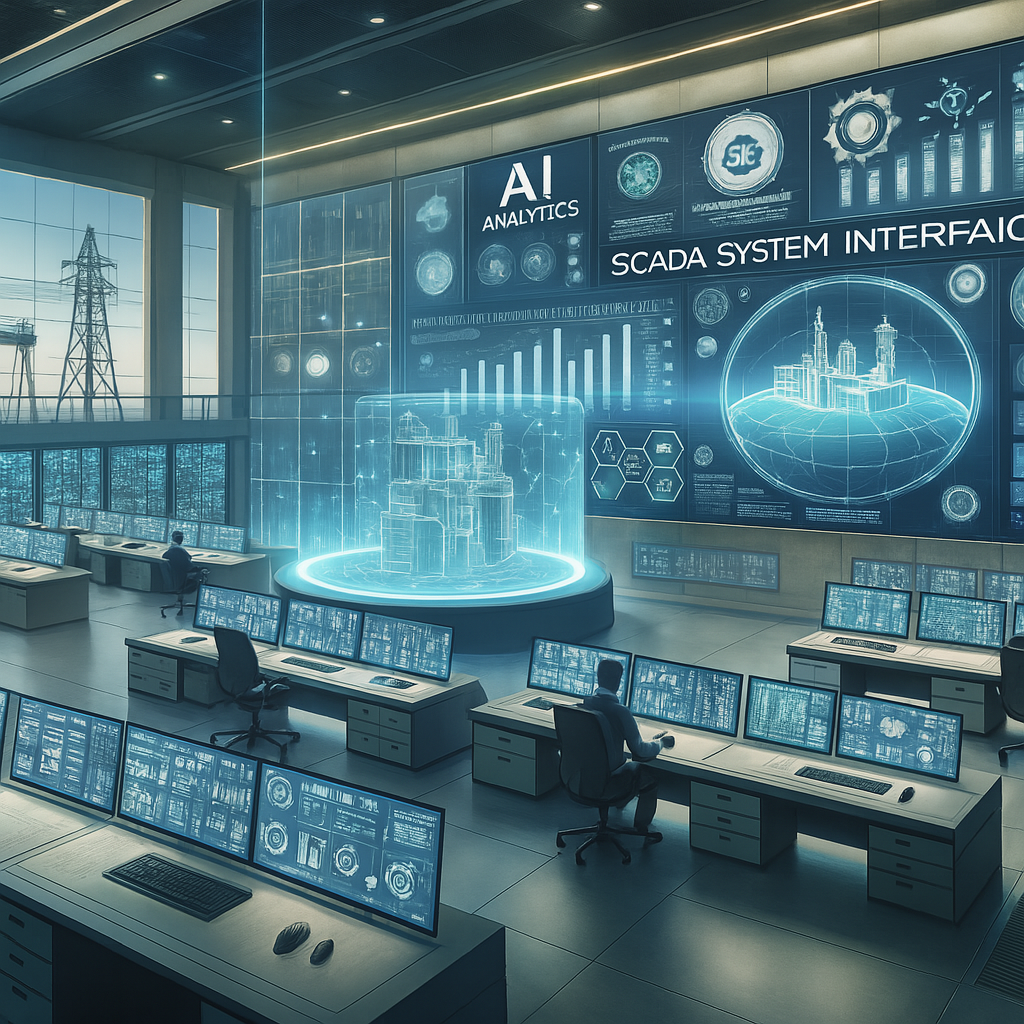 A SCADA system control room with AI-driven analytics, multiple operator stations, and a central holographic interface.[/caption]
1. Industry 4.0 and Smart SCADA Systems
SCADA is playing a key role in Industry 4.0, where industrial automation is transitioning towards intelligent, interconnected, and autonomous operations.
Key Advancements
- Digital Twin Technology: SCADA is integrating digital twin models, allowing real-time simulation of industrial processes before implementing physical changes. Reduces downtime and improves predictive maintenance.
- Cyber-Physical Systems (CPS): SCADA is merging with AI-driven automation, enabling real-time self-optimizing systems. Machines can automate adjustments without human intervention.
- Edge Computing for Faster Decisions: SCADA will process data at the edge, reducing reliance on centralized servers. Enables faster decision-making and reduced latency in industrial automation.
Example: Smart Manufacturing - SCADA with CPS is enabling self-regulating production lines, reducing material waste by 18%.
2. Cloud-Based SCADA and Remote Access
Cloud technology is revolutionizing SCADA by offering scalability, cost reduction, and remote accessibility.
Key Advancements
- SCADA-as-a-Service (SCADAaaS): SCADA systems are moving to the cloud, offering on-demand services with no need for expensive on-premise infrastructure.
- Real-Time Remote Monitoring: Operators can access SCADA dashboards from mobile devices or web applications, improving flexibility and responsiveness.
- Automated Backups and Disaster Recovery: Cloud-based SCADA provides secure data storage and instant recovery, preventing data loss due to cyberattacks or system failures.
Example: Smart Energy Grids - Cloud-based SCADA in power distribution networks reduced outages by 30% through real-time demand monitoring.
3. AI and Machine Learning in SCADA
Artificial Intelligence (AI) and Machine Learning (ML) are making SCADA smarter by enabling predictive analytics and automated decision-making.
Key Advancements
- Predictive Maintenance: AI-powered SCADA predicts equipment failures before they occur, preventing unexpected downtimes and extending machine lifespan.
- Anomaly Detection & Automated Responses: SCADA uses AI to detect irregularities (e.g., unusual temperature spikes) and automatically adjusts machine settings to prevent damage.
- Self-Learning Systems: ML algorithms analyze historical data to continuously improve operations, optimizing energy consumption and production efficiency.
Example: Oil & Gas Pipeline Monitoring - AI-enabled SCADA prevented pipeline leaks, reducing maintenance costs by 20%.
4. IoT-Enabled SCADA for Smart Industries
The Internet of Things (IoT) is reshaping SCADA, making it more connected, intelligent, and scalable.
Key Advancements
- IoT Sensors for Smart Monitoring: SCADA systems now integrate with low-power IoT sensors that continuously monitor air quality, machine vibrations, fluid flow, etc.
- MQTT-Based Communication for Low Bandwidth: Lightweight IoT protocols (e.g., MQTT) improve SCADA’s data transmission efficiency, suitable for remote industries like agriculture, offshore oil rigs, and mining.
- IoT-Enabled Remote Control: Operators can control SCADA from any location using IoT-connected devices. Useful for wind farms, remote factories, and smart water treatment plants.
Example: Smart Agriculture - IoT-based SCADA reduced water usage by 40% by monitoring soil moisture in real time.
5. Enhanced Cybersecurity for SCADA Systems
With SCADA becoming more connected, cybersecurity is a major concern. Advanced security measures are essential to protect industrial control systems.
Key Advancements
- Zero-Trust Security Models: Strict access control policies ensure that only authorized personnel can modify SCADA systems. Multi-factor authentication (MFA) prevents unauthorized access.
- Blockchain for Data Integrity: Blockchain ensures tamper-proof SCADA logs, preventing cyberattacks and providing secure transaction records for utilities and smart grids.
- AI-Powered Threat Detection: AI monitors SCADA networks for cyber threats in real time and automatically isolates infected systems to prevent damage.
Example: Smart Grid Cybersecurity - AI-enhanced SCADA reduced cybersecurity breaches by 50% in critical power infrastructure.
6. SCADA for Green Energy and Sustainability 🌱
As industries shift towards sustainable operations, SCADA is evolving to support renewable energy and environmental monitoring.
Key Advancements
- SCADA in Smart Grids: Helps manage renewable energy sources (solar, wind, hydro) and balances grid load fluctuations for stable energy distribution.
- Carbon Emission Monitoring: Tracks and optimizes factory emissions, energy usage, and waste generation, ensuring compliance with environmental regulations.
- Water and Waste Management: SCADA in wastewater treatment plants helps recycle and reuse water efficiently.
Example: Smart Renewable Energy Plant - SCADA optimized wind farm energy output by 25%, reducing dependence on fossil fuels.
Future-Proofing SCADA: What’s Next?
As SCADA evolves, industries must prepare for upcoming trends:
| Future Trend | Expected Impact |
|---|---|
| Quantum Computing | Faster data processing for ultra-complex SCADA calculations. |
| 5G Integration | Low-latency communication for real-time control of industrial systems. |
| Augmented Reality (AR) HMIs | Operators can visualize SCADA systems through smart glasses for maintenance. |
| Self-Healing SCADA Networks | AI-driven SCADA will automatically repair system failures. |
SCADA is no longer just about monitoring and control-it is becoming smarter, more secure, and highly automated. By embracing AI, cloud computing, IoT, and cybersecurity advancements, SCADA will transform industries, making them more efficient, sustainable, and resilient.